
How to Talk to Kids About God: A Parent's Guide
Last Updated: October 30, 2026
Quick Summary
Talk to kids about God early, in short, warm and honest conversations that use simple language. Start with one clear idea, such as God loves you, and use Bible stories and everyday questions to build from there.
- Start with one simple idea, such as God made the world and loves you.
- Use a children's Bible with large pictures for ages 3 to 8, reading a few minutes each day.
- Say "I don't know, let's find out together" when you lack an answer.
- Name the feeling behind a hard question before giving your answer.
- Make faith routine with a short prayer before meals or a verse at bedtime.
Table of Contents
- Why Talking to Kids About God Matters Early On
- Step 1: Start With Who God Is in Simple Terms
- Step 2: Introduce God Through Jesus and Bible Stories
- Step 3: Answer Common Questions Kids Ask About God
- Step 4: Handle Doubt, Fear and Difficult Questions
- Step 5: Talk About Religion Respectfully in Diverse Families
- Step 6: Make Faith Part of Everyday Family Life
- Your Next Step: Start a Simple Family Conversation This Week
- Frequently Asked Questions
Why Talking to Kids About God Matters Early On
Many American parents want to talk about faith with their children, but they often wait for the "right" moment to talk to kids about God. A common mistake is treating faith as a topic for older kids.
This guide walks through six practical steps for how to talk to kids about God, along with the questions parents ask most often. The goal is simple: give you words you can actually use at the kitchen table, in the car, or at bedtime.
Early conversations shape how a child understands God, love and trust. Keep them short, warm and honest. You do not need a perfect answer every time.
Step 1: Start With Who God Is in Simple Terms
Start with a short, clear idea. Children do best with plain language and a single main point, such as "God made the world and loves you."
- Use words a young child already knows, like "love," "world" and "family"
- Keep each answer to one or two sentences
- Repeat the same core message over time
Describing the Invisible God to Young Children
Kids often ask, "Where is God?" or "Can I see God?" A helpful answer is: "God is with us all the time, even though we cannot see Him." You can point to things you cannot see but know are real, like the wind or your own thoughts, to help them picture the idea.
Step 2: Introduce God Through Jesus and Bible Stories
Many Christian families use Jesus as the easiest way into the faith. Stories are easier for kids to remember than abstract ideas. Choose one short story per conversation, such as Noah's ark, David and Goliath, or the birth of Jesus.
Choosing a Children's Bible and Reading Together
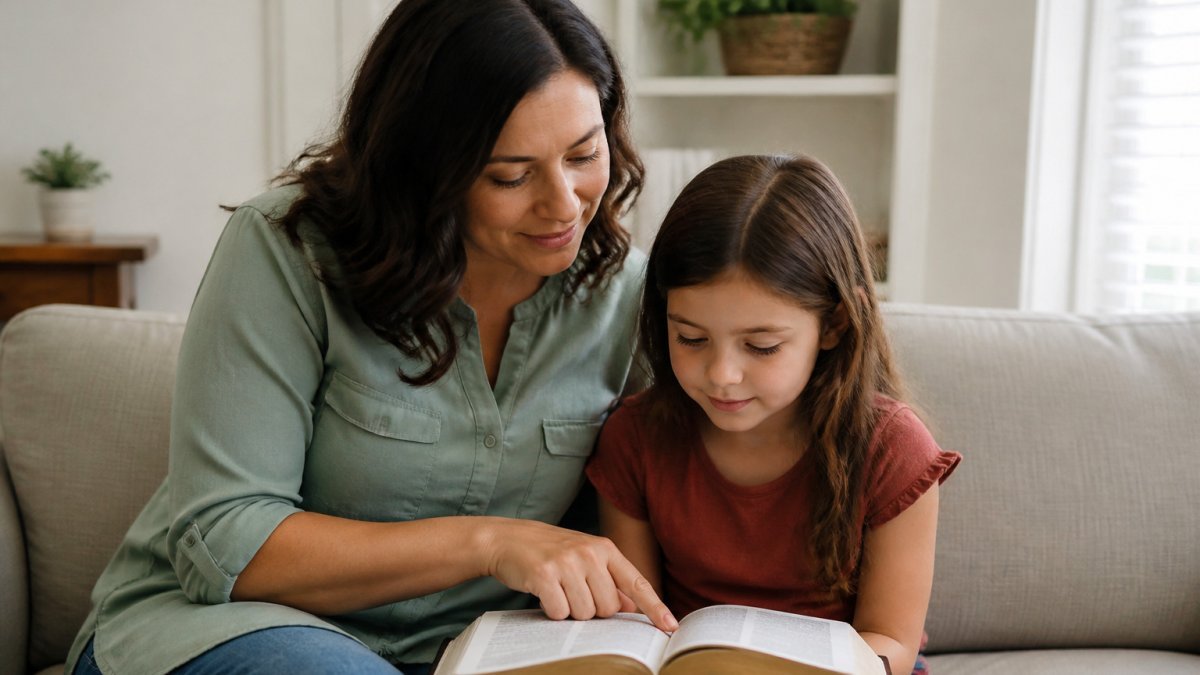
A children's Bible with large pictures and short passages works well for ages 3 to 8. Read a few minutes each day, then ask one simple question, like "What did the people in the story feel?" Let your child turn the pages and point to pictures they like.
Step 3: Answer Common Questions Kids Ask About God
Children ask direct questions, such as "Who made God?", "Does God sleep?" or "Why can't we see God?" Answer with what you believe and keep it age-appropriate. A short answer that feels true is better than a long one that confuses.
Responding When You Do Not Know the Answer
It is fine to say, "That is a great question. I do not know everything about God, but I know He loves us." Saying "let's find out together" also models curiosity. Many parents return to the question later with a Bible story or a pastor's help.
Here is a quick reference for some of the questions kids ask most.
| Question kids ask | Suggested approach | Key point |
|---|---|---|
| Where is God? / Can I see God? | Say God is with us though we cannot see Him | Compare to things we cannot see, like wind |
| Why didn't God answer my prayer? | Say sometimes the answer is yes, not yet, or different | It's okay to be disappointed with God |
| What happens when someone dies? | Say their body stopped working and they are with God | Add your tradition's teaching for older kids |
| Does God get mad at me when I'm bad? | Say God forgives you when you're sorry | Being sorry and trying again is the whole point |
| You don't know the answer | Say "I don't know, let's find out together" | Honest uncertainty models a faith that survives questions |
Step 4: Handle Doubt, Fear and Difficult Questions
Hard questions are not a sign that something has gone wrong. They are usually a sign that a child is thinking, trusting you, and trying to fit what they hear at church, school, and home into one picture. The goal is not to win the conversation, it is to stay in it.
A few ground rules help before you get to the specific questions:
- Answer the question that was asked. A five-year-old asking "Why did Grandpa die?" usually wants reassurance that death is not contagious and that you are not next, not a theology of the fall.
- Name the feeling before the answer. "That's a sad question. It makes me sad too sometimes" buys you a calmer listener.
- Keep the door open. End with "You can ask me that again anytime" so the topic does not feel closed.
Sample Responses to the Questions Kids Actually Ask
Use these as starting points and put them in your own words. Short beats thorough.
"Is God real? I can't see Him."
"I can't see God either. But I can't see the wind or love, and I know they're real. I see what God does, in the world He made and in how He takes care of us."
"What happens when someone dies?"
For a young child: "Their body stopped working, and they are with God, who loves them. We miss them, and it's okay to feel sad."
"Does God get mad at me when I'm bad?"
"God is not waiting to catch you. He loves you even when you mess up, and when you're sorry, He forgives you."
When the Doubt Is Your Child's Own
Around ages 8 to 12, some children start saying things like "I don't know if I believe that." Resist the urge to correct it immediately.
If fear or anxiety about God, death, or punishment is persistent and interfering with sleep or school, talk with your pastor or a children's ministry leader, and consider a licensed child counselor.

Step 5: Talk About Religion Respectfully in Diverse Families
Many households are not religiously uniform. One parent may be a committed churchgoer, the other a skeptic or a member of another faith. Grandparents may practice differently. Classmates, cousins, and neighbors will introduce religions your child has never heard of. None of that has to be a crisis, but it does need a plan, because children notice inconsistency long before they can articulate it.
When Parents Believe Differently
Start by agreeing on what you both can live with before the child is in the room. A few common patterns work:
- One believing parent, one not. The believing parent can share faith directly; the other can support by not undermining it, for example, by being present and respectful at bedtime prayers even without participating.
- Two different faiths. Decide together which traditions the child will be raised in, or how both will be presented. Children can handle "Mom prays in one way, Dad in another, and both are real to us" far better than they can handle being used as a battleground.
- Extended family with different beliefs. Agree in advance on a short, kind line your child can use: "We do things differently at our house, and we love Grandma anyway."
When Your Child Asks About Someone Else's Religion
A classmate is Muslim, a cousin is atheist, a friend celebrates a different holiday. The default response is curiosity, not correction:
"People believe different things about God, and that's been true for a very long time. Here's what our family believes. You can ask me anything about what other people believe, and we can learn about it together."
If your child asks whether a friend will go to heaven or whether a friend's religion is wrong, answer honestly within your tradition without turning the friend into a project. A workable frame: "I believe what I believe, and I trust God with people I love. What I know for sure is that we treat everyone with kindness."
Supporting Your Child's Own Beliefs as They Grow
Sharing your faith and controlling your child's faith are different things. Around the preteen years, children begin to own, or question, what they have been taught. A few practices keep the relationship intact through that shift:
- Invite rather than require participation in family prayer and church when your child is old enough to have a view.
- Ask before answering. "Do you want my thoughts, or do you just want to talk it through?"
- Let them disagree without consequences. A child who can say "I'm not sure I believe that" at the dinner table is not losing their faith, they are doing the work of building one.
Faith-inspired clothing can also open gentle conversations in mixed-faith settings. A simple piece like our Everyday Cross Tee can prompt a question that leads to a meaningful talk.

Step 6: Make Faith Part of Everyday Family Life
Faith grows through routine, not just special lessons. Build small habits, such as a short prayer before meals or a verse at bedtime. Consistency matters more than length.
- Pray together at breakfast or bedtime
- Sing a worship song in the car
- Talk about what you saw God do this week
Kids often copy what they see adults do. Let them see you pray and read Scripture for yourself.
For a playful way to start the conversation, our In God We Trust kids' tee gives little ones something to point to and talk about during Bible story time.

Your Next Step: Start a Simple Family Conversation This Week
Pick one question your child has asked recently. Answer it with one true sentence, then read a short Bible story together. That is enough for today. Keep the conversation going over the coming weeks, and let your child's questions guide you.
Frequently Asked Questions
When should parents start talking to children about God?
Parents can begin as soon as children start asking questions, which is often between ages two and four. Simple, repeated phrases such as God made the world and God loves you work well at this stage. Conversations grow in depth as children mature, so the goal is to keep the topic open and familiar rather than waiting for a formal lesson. Consistency matters more than timing, so talking about God during bedtime prayers, meals and car rides builds a natural foundation over the years.
How do I explain God to a 5-year-old?
Use concrete, familiar comparisons and short sentences. You might say God is someone who is always with us, even when we cannot see Him, and point to examples like the wind or love that we feel but do not see. Connect God to Jesus through Bible stories, since children understand stories more easily than abstract ideas. Let your child ask follow-up questions and keep answers brief, then check whether they understood by asking them to explain it back in their own words.
What should I say when my child asks a question I cannot answer?
It is fine to say, I do not know the answer to that, but let us find out together. Honest admissions build trust and model how faith includes humility and curiosity. You can read a relevant Bible passage together, pray about the question, or talk with your pastor or church leader. Avoid guessing or inventing answers, because children notice when adults are unsure, and a shared search teaches them that faith invites exploration.
How can I talk about God if my family has different beliefs?
Speak about your own faith in the first person, using phrases like we believe or our family prays, rather than making claims about what others must believe. Respect that relatives or classmates may hold different views, and teach children to listen kindly to people whose beliefs differ from theirs. If one parent does not share the same faith, agree on shared values such as kindness and honesty, and keep discussions calm and age-appropriate so children feel secure rather than caught in the middle.